No Need for too much Tradition
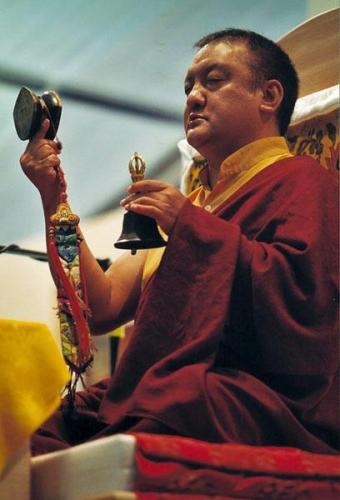
Kunzig Shamar Rinpoche, Vienna, September, 1993.
Some Western practitioners say that Tibetan Buddhism consists partly
of Tibetan tradition and partly of Dharma practice and that they
cannot always distinguish between the two. It is very important
to know the difference.
In the biographies of Milarepa, Marpa, and Gampopa everything is
pure Dharma. Everything about these great Kagyu masters - the way
they lived, the way they taught, and so on - was pure Dharma. For
example, Marpa brought the teachings from India to Tibet where he
taught as a Tibetan. He first studied Dharma in India according
to Indian tradition. Naropa, his teacher, was from India. Most of
the time Naropa was naked and sometimes he would wear the ornaments
of Heruka, but Marpa never told Tibetans that they should do the
same. When Marpa taught in Tibet, he did not try to introduce Indian
customs there, like wearing saddhu robes. He let the Tibetans wear
their Chuba (Tibetan clothes). He taught the Dharma in a very pure
way.
In the West you have read a lot about "Tibetan lamas."
Some Western scholars traveled to Tibet for adventure. Later in
America, Lobsang Rampa wrote books full of fantasies, including
stories of astral travels about one mind traveling to some other
mind and transmitting some messages. As a result of meditation,
highly realized Buddhist practitioners can understand such supernatural
things and can also read thoughts. When you develop a very, very
good meditation, you will be able to know unbelievable things. Buddha
for instance, knows all thoughts of every single sentient being.
Lobsang Rampa presented these phenomena quite differently. He made
something mysterious out of it. It was his fiction that somebody
sends his mind to somebody else in order to read his thoughts. His
books influenced Western ideas about Tibet. When people were translating
biographies into Western languages, they of course translated all
the "good stuff." In this way, many erroneous ideas about
Tibetan Buddhist saints developed; for instance, that they could
all fly around in the air.
You Westerners developed an idea that all Tibetan lamas are totally
pure. Whatever a lama would do, one would think, "Oh, there
must be some deep meaning behind it." When a lama seemed a
little bit unusual one would give it a special meaning and assume
that the lama must have seen something about one's mind. According
to my experience, many Western students have ideas like that.
Then you want to bring all the traditions into the Dharma practice
and think that the system of monasteries had something to do with
enlightenment. Today, when we have better communication, when one
can travel there and so on, sometimes people are shocked when they
see the differences between what they see and what their ideas were.
They think, "What is this? The lamas are like us, they have
similar problems." Some are then totally confused. But that
is the way it is. Lamas are just humans. In Kathmandu one can see
monks going to casinos. I can say this here because some of you
have seen it yourselves. I do not have to make it a secret.
What is this all about? A long time ago the system was introduced
in Tibet that very young children were brought to the monastery
where they were taken care of and fed for free. One very holy Tibetan
king got a bit extreme. In today's Afghanistan, there was a "Vajrayana
Kingdom" Oddiyana. That king achieved enlightenment and taught
all his subjects. They all became enlightened themselves and the
kingdom disappeared. The Tibetan king wanted to do the same. He
wanted to end samsara by letting the kingdom of Tibet disappear
so he introduced some new rules, and monasteries for monks and nuns
were erected all over the country. All monks and nuns received food
for free and the harvest from all farmers went to the monasteries.
As a result, the people became monks not only to become enlightened
but because there was free food. There were also enlightened ones,
but it was not the majority, maybe one in a million. Enlightened
beings were very rare there, because there were many distractions.
There was enough to eat, but not much to do. None of them practiced
like Milarepa in earlier times. So there was a monastery in every
valley and all of Tibet was filled with monasteries which had big
administrations.
In the beginning one Kagyu master founded a monastery the right
way by starting a study program and a meditation center. His wish
was that the teachings be preserved and not simply vanish. At that
time, there was no Tulku system (the system of the recognition of
consciously reborn Buddhist masters), so the master's son took responsibility
for the monastery after his father. In this way, many Kagyu monasteries
became large. But people are just people and as time passed, things
became worse. Monasteries became little kingdoms with very arrogant
administrators. They were often very cunning. They knew that spiritual
leaders were necessary to control the people so they would introduce
a spiritual leader, but tried to keep all the power in their own
hands. It was very political - on the outside spiritual, but on
the inside political. The administrators wanted to control the people.
Every monastery had land, sometimes extensive land. When monasteries
bordered one another, they each wanted to protect their own land.
They also needed a work force so the peasants became slaves of the
monasteries, and administrators reigned like dictators. Sometimes
they would fight for bordering land. When an animal from one monastery
crossed the border of the other monastery's territory, it would
be kept there, and so on.
The actual ruler of the country had hardly any power because each
monastery became so powerful and they were constantly fighting.
The government was completely powerless. Later they won some influence
and organized themselves like the monasteries so that the country
was controlled in a strictly religious manner. Good practitioners
were not a part of the administration. Good masters and good monks
practiced mainly alone. Almost nobody reached enlightenment in a
monastery, because they were organized so strictly by the administration.
Religion and politics were strongly mixed in Tibet. Politicians
used religion in order to control people. This was very difficult.
The problem was not the enlightened ones, but the administrators.
Westerners have the idea that everything that happened there was
Dharma. They think a monastery is a big mandala and every monk a
certain Buddha aspect and the guru is Dorje Chang.
You also think that the thrones of the lamas are a part of the
Dharma practice. Actually they may also be a cause for problems.
You have prepared a throne for me and I am sitting on it now. If
you do not do the same thing for somebody else problems might start.
This is the way of politics. If you had put a beautiful Western
chair here, nobody would have had any problem with it. Old Tibetan
lamas, even the good and friendly ones, have certain customs based
on their culture. When they come to the West and Tibetan musical
instruments are not being used, or the throne lacks beautiful brocade,
they feel that something is missing. They also will tell you that
you should arrange everything in a certain way and then you think
this is part of the practice. In this way you are building up Tibetan
tradition in the West and I do not think this will last. If it does,
however, it will be a source for problems in the future. Who should
have a higher throne? Somebody will have a smaller throne and somebody
else will have an even smaller one. In this way you will have many
problems.
You must see the difference between Dharma and tradition. When
problems occur, understand that they do not come from the enlightened
ones, but from the administrators. Even Chinese communists, who
do not at all believe in religious things, use religion from time
to time for political reasons because it is so powerful and so well
established. In the West you do not have to take this administrative
part that is mixed with religion. I do not mean by that, that your
teachers should now sit somewhere on the floor and you should point
your feet at them when you sit, but there is simply no need for
too much tradition.
|